
Product Data: The Foundation of Digital Performance
AI and automation transform how businesses operate, but they rely on one thing above all, strong data foundations. Product data is the fuel that powers search, discovery, personalisation, and conversion. Without it, even the best digital systems fail to perform.
Why Product Data Matters
Every product interaction, searching, comparing, or buying, depends on data. Descriptions, imagery, specifications, and attributes determine how products appear, how easily they can be found, and how confidently customers decide. Poor or missing data creates noise, confusion, and missed sales.
Structured, high-quality product data drives accuracy, consistency, and speed. It ensures your commerce, ERP, CRM, and logistics systems all speak the same language. When data is clean, integrated, and connected, it supports everything from sales, reporting and analytics to AI-driven recommendations.
From Purpose to Practice
Good data work starts with purpose: helping customers find, choose, and buy.
That means creating complete and accurate data quickly and cost-effectively. You must decide which products and attributes matter most and put information where customers need it most.
Success comes from clarity and structure. Define taxonomy and schema early. Automate repeatable tasks. Build roles and accountability so there are no grey areas. Bring in experts who understand the product and what customers need. Data quality is not a one-off project, it’s an ongoing discipline.
A Step-by-Step Approach
- Set your data priorities: Identify the products and data attributes that drive value. Ensure customers get the information they need to decide confidently.
- Make ownership clear: Create clear internal ownership. Data quality fails when accountability is shared but unclear.
- Bring in the right skills: Involve specialists who understand both product and customer context.
- Measure and improve: Measure gaps. Automate fixes where possible. Prioritise quick wins and high-impact improvements.
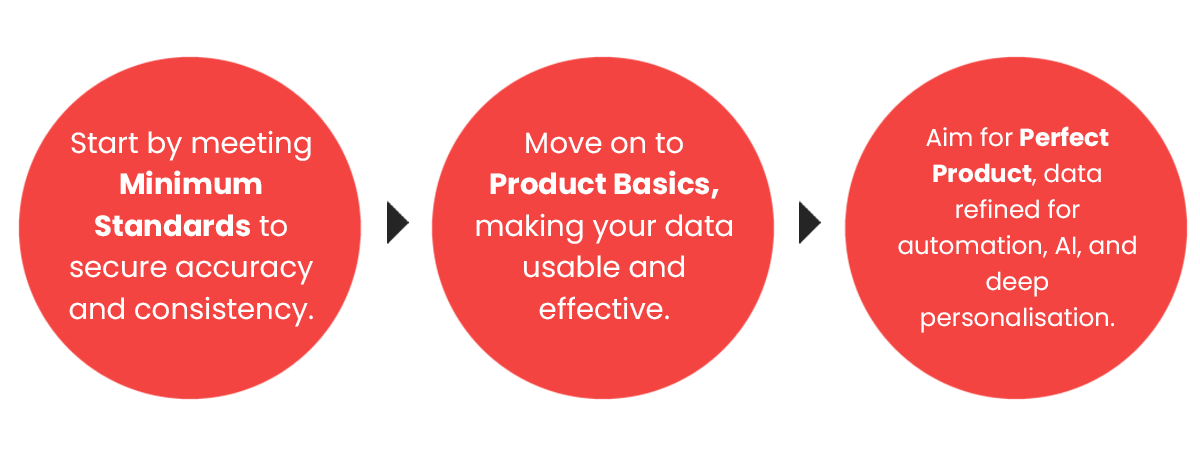
Progress happens in stages
Powering the Website Experience
Product data shapes every digital interaction. Search, browse, filters, and comparison all rely on it. Customers expect to find the right product fast, with no irrelevant results. They want simple visuals, clear information, and deeper content when needed. Voice and chat will extend this further, using data to guide and transact seamlessly.
Speed, clarity, and relevance beat aesthetic polish. A consistent experience across categories and touchpoints builds trust and drives conversion.
Shaping the Customer Journey
The customer journey, Find, Choose, Buy, runs on data.
Find: Clean taxonomy, relevant attributes, and clear categorisation. Guided search that delivers only what users expect.
Choose: Immediate recognition, simple imagery, and confident decisions. Rich data makes comparisons fast and easy.
Buy: A frictionless experience. Clear value, seamless online-offline integration, and the right mix of automation and human support.
When data aligns with purpose, customers move through the journey naturally, reducing effort and increasing satisfaction.
Measuring What Matters
You can’t improve what you don’t measure. Track fill rates in ERP or PIM systems, search relevance, and conversion impact. Monitor consistency across systems. Use gap analysis to focus resources and quantify value.
Conclusion
Strong product data underpins every aspect of digital commerce. It defines how customers experience your offer and how well your organisation executes its strategy. Start with purpose. Focus on products, categories, and attributes that make the biggest difference. Measure relentlessly. Improve continuously.
Product data excellence is not a destination, it’s a discipline. Those who master it build the foundations for AI, automation, and sustainable digital growth.